
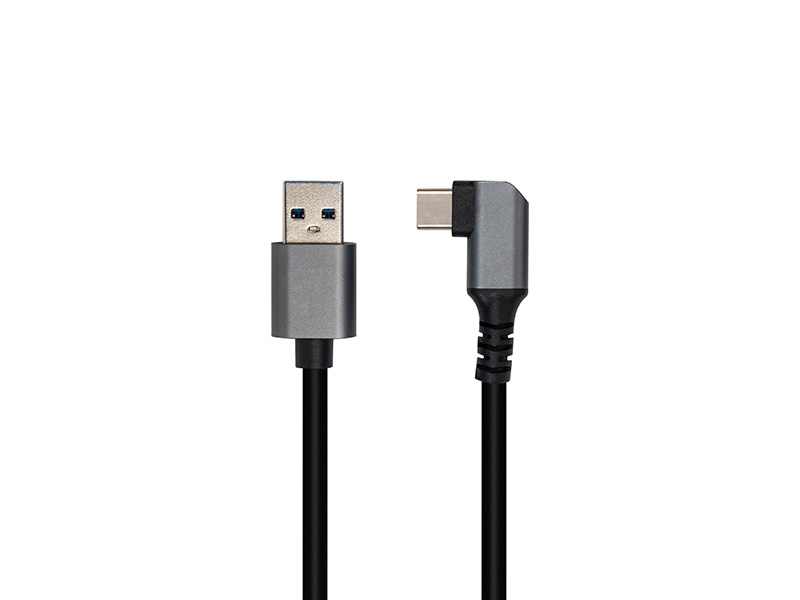
In the era of widespread smartphone adoption, the Type-C interface has become a standard feature for flagship and mid-range Android models, with fast charging emerging as a key consideration for users when purchasing devices. During daily charging, many encounter confusion: despite switching to high-power chargers, their phones still charge slowly; or when using an original fast charger with a standard data cable, they fail to achieve full-speed charging. So, does the fast charging speed of a Type-C phone depend on the charger or the cable? Additionally, many users wonder what the official maximum power for Type-C fast charging is and what the actual fast charging limits are for phones and devices. This article will comprehensively analyze the core logic of Type-C fast charging from the perspectives of principles, division of roles, standards, and practical scenarios, addressing the common confusions among the public.
1. Core Conclusion: Fast charging is not determined by a single device but by the weakest link among three factors
First, dispel the common misconception: the fast charging speed of Type-C mobile phones is not solely determined by the charging head or the charging cable, but by the combined performance of the charging head, charging cable, and the phone itself. The overall speed is capped by the weakest link among these three components. Each plays a distinct role and is indispensable—any one of them failing to meet the required specifications will prevent achieving full-power fast charging. In simpler terms, the phone acts as the “receiving terminal” in fast charging, dictating its maximum power tolerance; the charging head serves as the “energy supply terminal,” determining the output power limit; and the charging cable functions as the “transmission channel,” governing the power delivery capacity. Only when these three components are properly matched can optimal fast charging performance be achieved.
Many users mistakenly believe that “using a high-power charging head enables fast charging” or that “any original cable can work with any head for fast charging.” The core issue is neglecting the protocol handshake and hardware matching logic required for fast charging. Type-C fast charging is not merely about power delivery but an intelligent negotiation process between devices: when the charging connection is established, the phone, charging head, and data cable quickly complete protocol matching and specification verification. Only after confirming mutual support for fast charging protocols and consistent voltage/current parameters does the high-power charging mode activate. If any component fails to match, the system automatically degrades to standard slow charging.
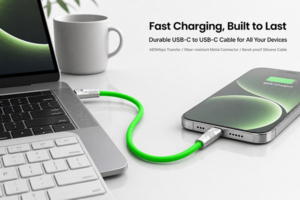
240W/40Gbps silicone charging cable
II. Core Division of Charging Heads and Cables: Each Determines Key Dimensions of Fast Charging
1. Charger head: Determines the power limit of fast charging and protocol compatibility
The charging head is the core power source of the entire fast-charging system and a critical component that determines the upper limit of fast charging. Its primary function is to convert household 220V AC power into low-voltage DC power suitable for mobile devices, while also providing multi-tier voltage and current output solutions, along with integrated fast-charging protocol chips.
On one hand, the rated maximum power of the charging head directly sets the upper limit of charging. For example, a 66W charging head can only output up to 66W, even when paired with top-tier cables and a phone that supports 120W fast charging—the final charging power will still be capped at 66W. On the other hand, the matching of fast-charging protocols is entirely determined by the charging head. Currently, mainstream fast-charging protocols are divided into two categories: universal protocols and proprietary protocols. The universal USB PD protocol works with most digital devices, while Huawei SCP, Xiaomi QC, OPPO VOOC, and others are proprietary fast-charging protocols developed by manufacturers.
If the charging head does not support the fast charging protocol corresponding to the phone, even with higher power, fast charging cannot be triggered, and it will default to the 5V standard slow charging mode. It can be said that the charging head is the “power source” of fast charging. Without a high-power, protocol-matched charging head, even the best cables cannot achieve fast charging.
2. Charging cable: Determines the transmission stability and current-carrying upper limit of fast charging
Compared to charging heads, many people overlook the core role of Type-C data cables, yet they are the “critical bottleneck” for high-power fast charging. Data cables do not generate electricity or determine the overall power limit, but they dictate whether the high power from the charging head can be fully and stably transmitted to the phone. The key difference between standard Type-C cables and fast-charging cables lies in the specifications of the conductors, resistance levels, and whether they feature an E-Marker smart chip.
Ordinary Type-C cables have thin conductors and high resistance, supporting only small current transmission within 3A and a maximum power capacity of 60W, making them unsuitable for high-current fast charging scenarios. In contrast, high-power fast charging cables feature thickened copper-plated conductors and low-impedance design, along with an E-Marker chip specifically for identifying and negotiating high-power charging specifications, which is essential for achieving fast charging above 60W. Using standard thin cables with 100W or 120W high-power charging heads would trigger the cable’s protection mechanism due to its inability to handle high current, limiting output and resulting in issues such as reduced charging speed, overheating, power fluctuations, and intermittent charging.
Simple breakdown of responsibilities: The power adapter determines “whether it can output high power,” the charging cable determines “whether high power can be transmitted,” and the phone determines “whether it can receive high power.” Among the three, the power adapter sets the baseline limit, the cable ensures transmission and delivery, and the phone defines the final reception limit.
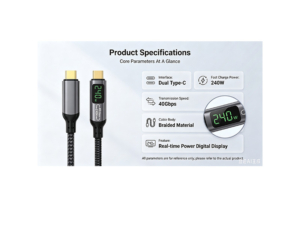
digital display fast charging cable
III. Detailed Explanation of the Official Maximum Power Standard for Fast Charging via Type-C Interface
Many users are confused about the maximum power limit of Type-C fast charging. Currently, the industry’s general standard is set by the USB-IF Association, which is the globally unified USB PD fast charging protocol standard, while also distinguishing between two major power ranges: standard power and extended power.
In the USB PD 3.1 protocol released by the USB-IF Association in 2021, the official maximum power limit for fast charging via Type-C interfaces was officially raised to 240W, which is currently the highest industry standard for Type-C interfaces. This standard divides fast charging power into two tiers: the Standard Power Range (SPR), which aligns with the PD3.0 specification and supports up to 100W (20V/5A), suitable for most smartphones, tablets, and ultrabooks; and the Extended Power Range (EPR), supporting the ultra-high specification of 48V/5A, with a peak power of up to 240W, primarily targeting high-power devices such as gaming laptops and high-performance digital equipment.
It is important to distinguish that 240W is the theoretical maximum power rating for the Type-C interface, not the maximum fast charging power for smartphones. Due to limitations such as battery capacity, device heat dissipation, and safety protections, current consumer-grade smartphones’ Type-C fast charging capabilities far fall short of the 240W standard. Mainstream flagship models on the market typically offer fast charging speeds ranging from 80W to 120W, with some top-tier variants reaching 160W or 200W. These represent vendor-specific proprietary protocols for overclocked fast charging, not the universal USB PD standard power levels.
Meanwhile, achieving 240W full-power Type-C fast charging requires a complete set of hardware compatibility: a 240W charging head supporting PD3.1 EPR protocol, a 240W dedicated Type-C cable equipped with an E-Marker chip, and a terminal device capable of receiving 240W. All three components are indispensable. Currently, there are almost no compatible models in the mobile phone category, as this power level is primarily applied to desktop devices and high-performance laptops.
IV. Avoiding Pitfalls in Daily Fast Charging: Correct Pairing for Full-Speed Charging
Based on the above principles, to maximize your phone’s fast-charging capabilities in daily use, there’s no need to blindly pursue ultra-high-power accessories. Simply follow the matching principle. First, prioritize using the original fast-charging kit from your phone manufacturer. The original head and cable undergo deep manufacturer adaptation, ensuring fully compatible protocols and specifications, making it the most stable and safest fast-charging combination.
Secondly, third-party accessories must be selected with precise parameter matching. If the phone supports proprietary fast charging protocols, a high-power charger compatible with the corresponding protocol should be chosen, paired with a 5A Type-C cable featuring an E-Marker chip. For universal PD fast charging, there’s no need to pursue the 240W top tier—select a 100W PD charger and 5A cable if the phone supports up to 100W, avoiding over-performance.

